

ONG (Setor Social)
Volunteer Opportunity: Researching Crowdsourced Data Collection and Neighborhood Monitoring Technologies
Detalhes
Descrição
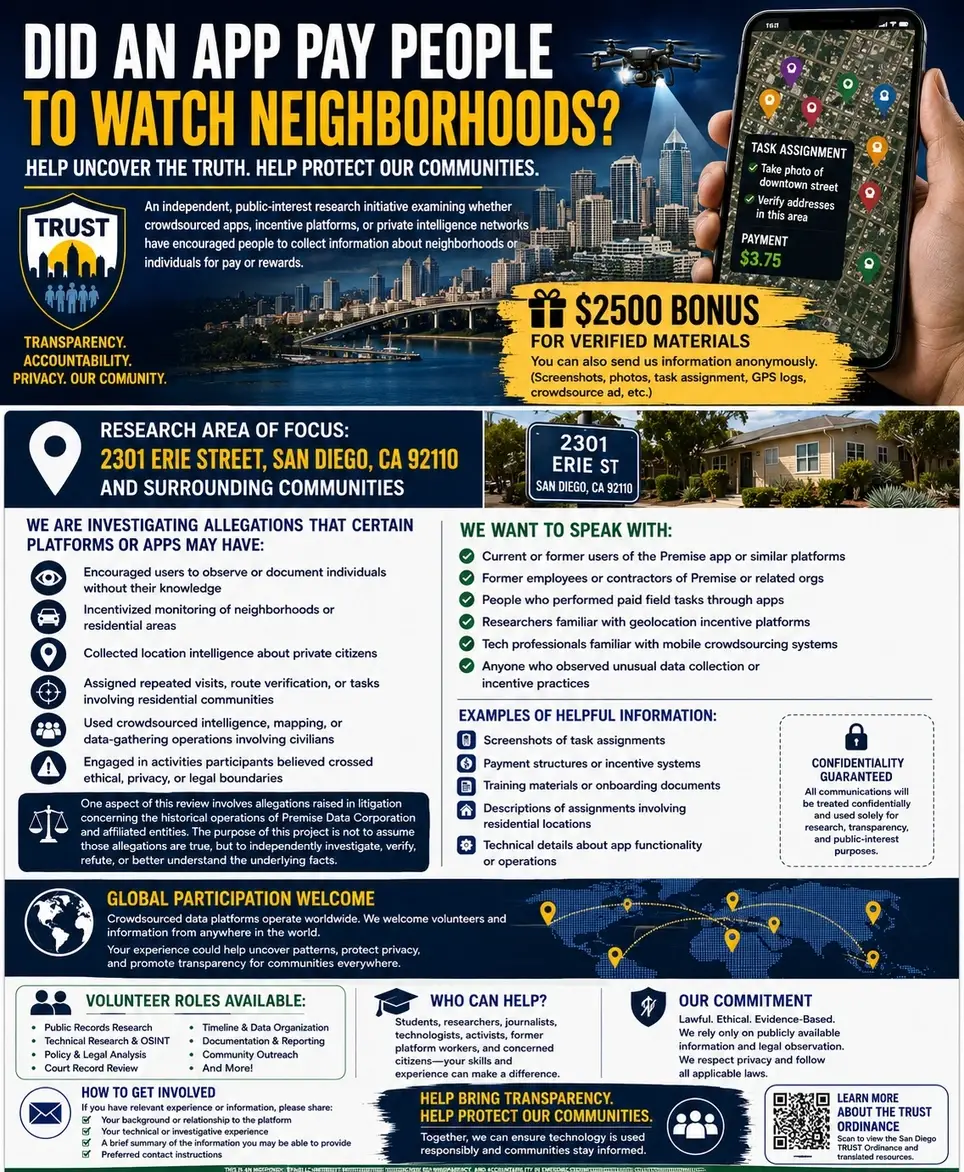
Help Investigate Emerging Questions About Privacy, Incentive Platforms, and Community Transparency
Location of Primary Research Interest:
Morena / Bay Park / Clairemont Communities
San Diego, California 92110
Global Participation Welcome
Although portions of this research currently focus on events and public records originating in San Diego and the implementation of the San Diego TRUST Ordinance, the broader questions under investigation are not unique to any one city, state, or country.
Crowdsourced data collection platforms, geolocation incentive applications, mapping technologies, and distributed observation networks operate internationally and often rely upon participants located across multiple jurisdictions.
Accordingly, this project welcomes participation from volunteers, researchers, former platform workers, technologists, and community members located anywhere in the world who possess information, expertise, or experience that may contribute to a better understanding of these technologies and their potential impact on privacy, transparency, and civil liberties.
Volunteer Opportunity
Research Support, Documentation, Public Records, and Technical Analysis
Confidential and Anonymous Submissions Welcome
Project Overview
An independent public-interest research initiative is seeking volunteers, researchers, technologists, journalists, former platform workers, and community members to assist with an ongoing examination of crowdsourced data collection technologies, location-based incentive platforms, and surveillance transparency issues affecting communities throughout San Diego.
This project is part of a broader effort examining questions surrounding municipal transparency, surveillance oversight, privacy protections, and compliance with local laws governing surveillance technologies, including the San Diego TRUST Ordinance.
Research Questions
Researchers are currently examining an important public question:
Could certain incentive-based mobile applications or crowdsourced data platforms encourage participants to collect information about neighborhoods, locations, or individuals in ways that raise privacy or ethical concerns?
Many modern applications compensate users for completing tasks involving:
- photography;
- mapping;
- geospatial verification;
- traffic observations;
- business visits;
- route verification;
- location intelligence collection; and
- market research activities.
The overwhelming majority of these activities are lawful and legitimate.
However, researchers are interested in understanding whether any participants have ever encountered assignments that they believed blurred the line between ordinary data collection and activities affecting the privacy of private citizens or residential communities.
Areas of Interest
Researchers are particularly interested in information involving:
- location-based task assignments;
- geospatial data collection systems;
- mobile incentive applications;
- field research assignments;
- crowdsourced intelligence platforms;
- mapping technologies;
- observational data collection practices; and
- privacy protections associated with these systems.
Examples of questions currently under review include whether participants were ever asked to:
- repeatedly visit specific neighborhoods or locations;
- collect information near residential properties;
- document activity occurring within communities;
- conduct repeated route verification assignments;
- collect localized behavioral or traffic information; or
- participate in activities they later believed raised ethical or privacy concerns.
Ongoing Research Concerning Residential Communities
A portion of the current research effort involves community reports originating from the vicinity of:
2301 Erie Street
San Diego, California 92110
Residents in the area have reported concerns involving:
- unusual vehicle activity;
- repeated neighborhood observations;
- persistent aerial activity;
- privacy concerns; and
- questions regarding the use of surveillance technologies in residential settings.
These reports remain unverified and are currently the subject of independent investigation, public records requests, and litigation.
The purpose of this project is not to confirm those allegations, but rather to determine whether objective evidence exists that supports or refutes them.
Individuals We Would Like to Speak With
We welcome confidential conversations with:
- current or former users of crowdsourced mobile applications;
- former employees or contractors of geospatial data companies;
- individuals who completed paid field assignments through mobile platforms;
- technology professionals familiar with location intelligence systems;
- privacy researchers;
- open-source intelligence researchers;
- civic technologists;
- public records researchers; and
- community members with relevant observations.
Helpful Information May Include
Examples of materials that may assist researchers include:
- screenshots of assignments or task prompts;
- onboarding or training materials;
- publicly available advertisements;
- payment structures or compensation models;
- descriptions of assignment categories;
- technical information regarding application functionality;
- anonymized GPS or route information; and
- documentation concerning privacy policies or operational practices.
Anonymous submissions are welcome.
Volunteer Roles Available
- Public Records Research
- Technical Research
- Open-Source Intelligence (OSINT)
- Policy Analysis
- Court Record Review
- Community Outreach
- Data Organization
- Timeline Construction
- Documentation and Reporting
Ideal Backgrounds
- Journalism
- Law and Public Policy
- Computer Science
- Privacy Research
- Data Science
- GIS and Mapping
- Investigative Research
- Public Administration
- Civil Rights Advocacy
- Government Accountability Work
Students and early-career professionals interested in privacy, technology governance, surveillance oversight, and public accountability are encouraged to apply.
Our Commitment
This project is committed to:
- lawful research practices;
- evidence-based reporting;
- respect for privacy rights;
- transparency;
- neutrality; and
- compliance with all applicable laws.
We are not seeking confidential government information, proprietary trade secrets, or unlawfully obtained materials.
How to Participate
Please provide:
- Your background or area of expertise;
- Relevant experience with technology or research;
- The type of information you may be able to contribute; and
- Your preferred contact method.
Anonymous submissions and confidential communications are welcome.
Technology evolves quickly.
Public transparency and accountability should evolve with it.
This project exists to help communities better understand the technologies operating around them and to ensure that innovation and privacy protections advance together.