
Organización sin fin de lucro
Seeking 2026 Digital Media Partner: Help Build the "Bridge of Parental Restoration"
Descripción
Descripción
The Mission: Mending Our Mistakes, Inc. (M.O.M.) is a family advocacy nonprofit dedicated to Parental Restoration. We work with noncustodial parents—those who have faced setbacks but are committed to growth—to help them stabilize their lives and safely reconnect with their children.
We are currently championing the Parental Restoration Act, moving the conversation from a punitive courtroom culture to a "Fellowship" model of support and accountability.
The Opportunity: We are seeking a Strategic Digital Media Partner (Agency, Creative Team, or Senior Professional) to adopt M.O.M. as a 2026 Social Impact client. We have the framework, the legislative momentum, and the lived experience; we need your creative expertise to build the "Bridge" that connects our mission to the world.
What You Will Help Us Build:
- The Restoration Hub: Refining our web presence to serve as a professional resource for parents, legal professionals, and lawmakers.
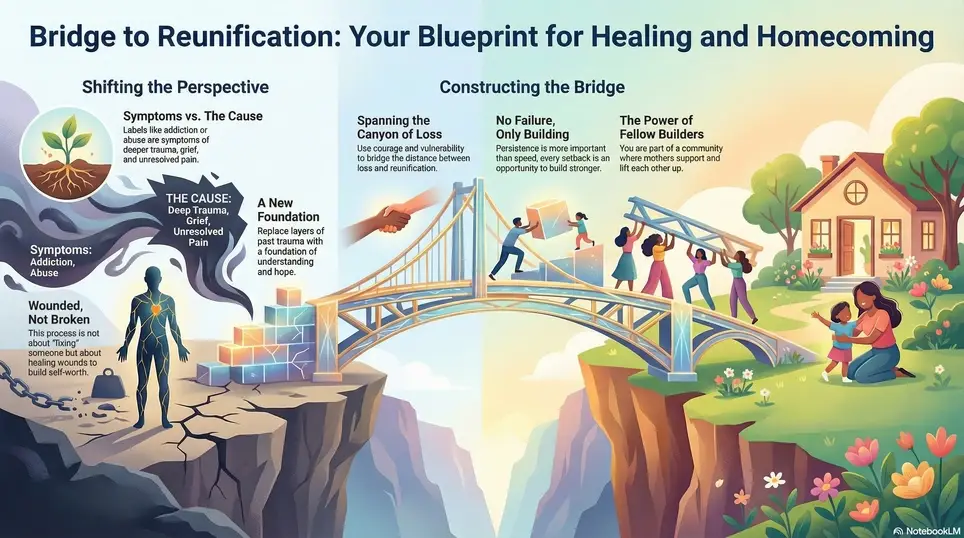
- Visual Storytelling: Creating high-impact video and graphic content that illustrates the "Bridge of Restoration" and humanizes the families we serve.
- Legislative Identity: Developing the visual brand for the Parental Restoration Act as we present it to state officials.
Why Join the Fellowship? By partnering with us, you aren't just helping a nonprofit; you are helping change the law and reunite families. You will be credited as our Founding Digital Media Partner on our website and in all 2026 mission briefings.
How to Apply: Please send a brief introduction and a link to your work. We are ready to share our full project blueprints and framework with the right partner.
What is Parental Restoration? An excerpt from one of our books is listed below if you want an in-depth understanding of exactly what you will be representing:
Introduction: The Fellowship and the Bridge
To the parent who made the hard decision to pick up this book, welcome. Just know that you are not alone here.
The kind of grief you are carrying is hard to explain to people who have never lived it. They do not know what it feels like to sit on the floor of your child’s room crying as you hold their favorite stuffed animal because it still smells like them. They do not know what it feels like to avoid that room completely because some days you cannot handle the silence.
They do not know what it feels like to hand your child back at the end of a visit and then cry in the car before you can even turn the key. They do not know what it feels like to show up to a school event and stand in the back by yourself, wondering if people are whispering about who you are and why you are not around more.
This space is for people like us. Mothers. Fathers. Grandparents. Former guardians. Anyone who loves a child and is trying to figure out how to keep loving them from farther away than they ever wanted to.
Right now, your life may feel shattered. You may feel ashamed, angry, exhausted, or numb. You may not know what to do next.
That is what this book is for.
Not to judge you. Not to excuse what needs to be changed. But to help you build something steady out of what feels broken.
We call it Parental Restoration.
What We Are (and What We Are Not)
We are a group of parents trying to rebuild our lives and our relationships with our children. Some of us are just starting. Some of us are farther down the road. None of us are perfect.
We believe in telling the truth, even when it is ugly. We believe in taking responsibility where we need to. We believe people can change. We believe God still meets people in the middle of the mess and helps them keep going when they are too tired to do it alone.
This is not a courtroom.
Nobody here is keeping score. Nobody here is waiting for you to mess up so they can hold it against you later. You do not have to prove that you are hurting enough to deserve support.
We are also not here to tell you that everything is somebody else’s fault. Sometimes other people have hurt us. Sometimes the system has failed us. Sometimes we have made choices we wish we could take back. Most of the time, it is some combination of all three.
This book will not give you legal advice or magic answers. It will not help you avoid the hard parts. What it can do is help you face them without disappearing from your own life.
That is what Parental Restoration is.
The Canyon of Custody Loss
Right now, there is a gap between where you are and where you want to be.
On one side is your current life: court orders, visitation schedules, child support papers, old mistakes, missed holidays, empty bedrooms, and all the things you wish you could do differently.
On the other side is the life you still want with your child. The school pickups. The inside jokes. The late-night talks. The ordinary things most people take for granted.
Between those two places is what we call the Canyon of Custody Loss. It is wide enough to make people feel hopeless.
Sometimes it feels like no matter what you do, you are still standing in the same place. You tell yourself stories about why it will never get better. You blame other people. Then you blame yourself. You try to fix everything overnight, fail, and decide that failure means nothing will ever change.
That is what this kind of grief does. It makes the distance feel permanent. But it is not.
You do not cross a canyon in one jump. You cross it slowly by building a structure that can span the distance.
You build that structure by telling the truth. By showing up. By keeping your word. By making one better choice today instead of waiting to become a completely different person tomorrow.
You build it by learning when to apologize and when to stay quiet. When to hold on and when to let go. When to fight and when to accept that some things take time.
The distance between you and your child may feel impossible right now. But impossible distances get crossed every day. Not all at once, but bit by bit.
God Knows This Ache
Some people come to a book like this angry at God.
Some feel like He abandoned them first. Some prayed for things to get better and watched everything fall apart anyway. Some do not know what they believe anymore. If that is where you are, nobody here is going to pressure you or pretend those feelings are wrong.
A lot of parents lose faith right alongside custody.
It is hard to trust God when you are sitting in a courtroom begging not to lose your child. It is hard to believe He is good when your house is quiet and your prayers feel like they are hitting the ceiling.
But one thing scripture shows us over and over is that God understands rejection.
He knows what it is like to love people that are just out of reach. He knows what it is like to keep reaching for people who do not answer. In Matthew 23:37, Jesus says He longed to gather His people together like a hen gathers her chicks under her wings, but they would not come.
God understands distance.
He understands what it feels like to keep loving someone when you cannot make them come closer.
That does not mean He stops loving them. And it does not mean you have to stop either.
Sometimes loving your child means letting go of control and focusing on becoming the kind of person they can trust if and when the door opens again.
Steady.
Honest.
Safe.
That kind of change does not happen overnight. But God can do a lot with a person who is willing to stay
The Wilderness Has a Purpose
You may feel like your life has stopped while everyone else keeps moving.
People still go to work. Kids still go to school. Holidays still show up on the calendar whether you are ready for them or not. Meanwhile, you are stuck in the same loop: paperwork, waiting, hoping, trying not to make things worse.
That is what the wilderness feels like.
The wilderness is not just pain. It is uncertainty. It is not knowing what happens next. It is realizing you cannot control people the way you thought you could. It is finding out that some of the things you built your life on were never strong enough to hold you in the first place.
Most people do not change when life is easy. They change when they run out of distractions.
In the wilderness, you find out whether you are honest or just convincing. Whether you are patient or just getting your way. Whether your faith is real or just something you talked about when life was going well.
Nobody wants to be here. But some of the strongest parts of a person are built in seasons they never would have chosen
A Fellowship of Builders
Nobody gets through this by themselves.
One of the worst parts of custody loss is how isolated it makes people feel. Friends stop asking questions. Family members do not know what to say. After a while, you stop talking because it feels easier than trying to explain.
That is why fellowship matters.
The people in these pages are not experts looking in from the outside. They are parents, grandparents, former addicts, recovering people, angry people, embarrassed people, people who have messed up badly and people who have been treated badly. Most of us are some combination of both.
We are going to tell the truth here.
Not just about what worked, but about what failed. Not just about what was done to us, but about the things we did that made everything worse. Those things matter too.
You do not build something strong by using cracked pieces. You build it by finding durable materials that can withstand harsh weather.
Some days you are going to need somebody else to carry you for a while. Some days you are going to be the one carrying somebody else.
You will soon come to find that is not weakness, it is just the only way to survive this rough terrain.
How This Book Works
This is not the kind of book you read once and put on a shelf.
Some parts are going to feel like somebody is sitting across from you telling the truth. Some parts are going to ask you questions you may not want to answer yet. Some parts are going to ask you to write things down, because it is a lot harder to lie to yourself when the words are staring back at you on paper.
There are practical parts too. Things you can actually do. Ways to communicate better. Ways to stop making things worse. Ways to show consistency when you do not feel consistent.
There will be scripture in these pages, but not in a way that talks down to you. The Bible is full of people who failed, ran, hid, lost things, made messes, and still found their way back to God. That is why it belongs here.
You are also going to notice that some ideas come up more than once: honesty, patience, accountability, forgiveness, boundaries, consistency. That is because most people do not change after hearing something one time. Most of us have to learn the same lesson a dozen different ways before it finally sticks.
If You Are Wondering Whether You Belong
Read these quietly and be honest with yourself.
- Do you replay old conversations in your head and think, “If I could do that over again, I would handle it differently”?
- Do you dread certain days because you already know they are going to hurt? Birthdays. Holidays. Court dates. School events.
- Do you feel like people have made up their minds about you without knowing the whole story?
- Do you tell people you are doing okay because the real answer is too messy and too exhausting to explain?
- Do you still hope things could be different, even if part of you is scared to hope too much?
- Do you want to become someone your child can trust, even if you know it is going to take time?
If you answered yes to even one of those questions, then you belong here.
Straight Answers to Common Objections
- “It’s too late.”
Maybe your child barely answers the phone now. Maybe they are old enough to have opinions about you that you cannot control. Maybe too much has happened and you do not know where you would even begin.
But people surprise us.
Children grow up. They ask different questions at thirty than they did at thirteen. They start seeing things differently. They stop repeating somebody else’s version of the story and start looking for their own.
“It’s too late” is usually fear pretending to be fact.
- “I already tried everything.”
Have you? Or have you tried everything except the things that made you uncomfortable?
Have you told the truth without defending yourself? Have you apologized without bringing up what the other person did? Have you stayed consistent when nobody noticed? Have you kept going when it stopped feeling fair?
Most people are willing to change as long as change still feels good. The hard part is changing when it does not.
- “I don’t do religion.”
You do not have to pretend to believe something you do not. A lot of people only start talking to God because they run out of people to talk to. If that is where you are, start there.
You do not need fancy prayers. You do not need church words. You can be angry. You can be confused. You can say, “If You are real, help me.”
That counts too.
- “What if my child never comes back?”
Then that will be a grief you carry. But it does not have to be the only thing you carry.
You can still become somebody honest. Somebody steady. Somebody who does not hate themselves every time they look in the mirror. Somebody who can love people without controlling them.
Even if the ending is not the one you wanted, your life is still your life.
The Bridge: What We Are Building
What we are building in this book is not just a better version of your old life. We are building something that has endurance.
The footings are what goes underneath everything else. Truth. Accountability. Honesty about what happened and what needs to change.
The piers are the supports. The people, routines, beliefs, and habits that keep your life from collapsing every time something goes wrong.
The span is the hardest part. It is the distance between where you are now and where you want to be. Most people want to leap across it. Real life does not work that way.
The deck is what your child, your family, and the people around you actually experience. It is the visible part. The part they walk on. The part that has to feel safe.
The guardrails are the things that keep you from destroying your own progress when you are angry, lonely, ashamed, tired, or afraid.
And maintenance is the understanding that this work is never really finished. Strong things stay strong because people keep taking care of them.
God’s Part and Our Part
“Unless the Lord builds the house, the builders labor in vain.” (Psalm 127:1)
There are some things only God can do, and there are some things only you can do.
You cannot make your child forgive you. You cannot make a judge see you differently. You cannot make an ex be fair. You cannot make people forget what happened.
A lot of parents wear themselves out trying to control things that do not belong to them. They replay conversations, obsess over court dates, check social media, rehearse arguments in their heads, and spend years trying to force an outcome they cannot force.
At some point, you have to separate what is yours from what is not.
Your honesty is yours. Your choices are yours. Your effort is yours. Your healing is yours. Other people’s reactions are not.
That is where faith comes in. Not as a way to avoid responsibility, but as a way to survive the things you cannot control.
Some pages in this book will ask you to pray. Not because prayer fixes everything overnight, but because some burdens are too heavy to carry alone for years at a time.
If you do not know what to say, keep it simple:
‘God, help me stop trying to control what does not belong to me. Help me do what is mine to do, and help me trust You with the rest.’
Why We Serve While We Build
“Carry each other’s burdens.” (Galatians 6:2)
We used to think we had to wait until we were fully restored before we could help anybody else. But most people do not get better alone.
Somebody else helped us when we were at our worst. Somebody else answered the phone, sat with us, prayed with us, told us the truth, or reminded us not to give up.
Now it is our turn to do that for somebody else.
You do not have to have everything figured out to help another parent. Sometimes all you have to say is, ‘I know what this feels like.’ That matters more than people realize.
We are not building this just for ourselves. We are building it for the people who come after us too.
When You Fall
“Though the righteous fall seven times, they rise again.” (Proverbs 24:16)
You are going to mess up. You are going to say the wrong thing, lose your temper, miss a call, break a promise, disappear for a while, or fall back into an old habit. That does not mean all your progress is gone.
A bad day is not the same thing as a bad life, and one bad decision is not the same thing as becoming the person you used to be.
What matters is what you do next. Tell the truth quickly. Do not waste months pretending it did not happen or blaming somebody else for it. Fix what you can fix. Apologize where you need to. Then go back to the things that were helping before you fell apart.
Most people do not get stuck because they made one mistake. They get stuck because they turn one mistake into ten more. You do not have to do that.
The Promises of Parental Restoration
- We will not let another person’s choices decide whether we live in peace.
- We will stop spending our lives in old conversations, old courtrooms, and old versions of ourselves.
- We will become people whose words and actions match.
- We will make our homes steadier, calmer, and more honest than they were before.
- We will let our children see change instead of just hear about it.
- We will learn how to be patient with slow progress and small victories.
- We will become trustworthy to ourselves again.
- We will learn how to love without controlling, help without rescuing, and stay without clinging.
- We will trust that God has not abandoned us, even in the parts of the story that still hurt.
- We will believe that restoration can begin before everything is fixed.
- We will keep building, even when the work is slow.
- We will not give up on ourselves, our children, or the possibility that something good can still be built from what is left.
For Parents Who Have Lost Faith
For parents who have lost faith, the hardest part is not always anger. Sometimes it is nothing.
You stop praying because it feels pointless. You stop going to church because you do not want to be around families who still look whole. You stop reading your Bible because every verse feels like it belongs to somebody else.
You may still believe in God somewhere deep down, but you do not feel close to Him anymore. Mostly you just feel tired.
If that is where you are, you are not broken beyond repair. You are worn out.
Sometimes faith does not come back all at once. Sometimes it starts with tiny things. Sitting in silence for five minutes. Reading one Psalm. Saying one honest sentence out loud. Driving home without turning the radio on because you need somewhere to put your thoughts.
You do not have to force yourself to feel something you do not feel.
You just have to leave a little room for the possibility that God is still here, even in the silence.
Your Beginning
This is where you start.
Not at the beginning of the story. That part already happened. The court dates happened. The phone calls happened. The mistakes happened. The things other people did happened too.
This is where you stop asking whether it should have happened and start deciding what you are going to do with it.
You do not need to know how the whole story ends yet. You do not need a five-year plan. You do not need to promise that you will never fail again.
You just need enough honesty to look at your life without flinching and enough willingness to believe it can still become something different than it is right now. That is enough to begin.
Pick up the first tool. We will show you how to use it. Walk the first ten feet. We will walk them with you.
Ubicación
Ubicación asociada
Por favor, llena este formulario
- Review Process: We are a mission-driven organization. We review applications on a rolling basis and will reach out to schedule a virtual "Fellowship Introduction" with candidates whose portfolios align with our 2026 vision.
- Confidentiality: As a partner, you will have access to sensitive frameworks and legislative drafts. We expect a high level of professional discretion.
- In-Kind Documentation: Mending Our Mistakes, Inc. is a registered nonprofit. For agencies or freelancers, we are happy to provide documentation of your pro bono hours for tax or Corporate Social Responsibility (CSR) reporting purposes.
- Next Steps: If selected for an interview, please be prepared to discuss how you would translate the "Bridge of Parental Restoration" concepts (included in the text above) into a digital strategy.
"Mending our mistakes is a journey we don't have to take alone. Thank you for considering joining our fellowship."