

For the third year in a row, Idealist has surveyed our communities of hiring managers and job seekers to better understand the state of work and job seeking in the U.S. nonprofit sector. This year, 537 administrators (referred to as hiring managers, though in some cases they are executive directors, operations staff, board members, or volunteers) and 5,311 job seekers answered the call between October and November 2025, using a variety of marketing tactics to reach these groups, both internal and external to Idealist.
What we learned about these communities reflects the ever-evolving world in which we find ourselves. 2025 marked a year of deep disruption in our sector and around the world, as many nonprofits, government agencies, universities, and even corporations lost funding or experienced budget cuts, forcing them to reevaluate programs, reduce staff, or even stop providing critical services to their communities. The impact of these disruptions are still being felt, and we expect them to deeply shape this year’s job seeking and hiring trends.
About Idealist
Since 1996, Idealist has been a trusted partner in the social-impact sector across the United States and beyond, connecting hundreds of thousands of organizations and millions of individuals who want to build a better world.
In 2025, we strengthened and furthered our mission by merging with VolunteerMatch, the world’s largest online platform for volunteerism. Organizations across our sector—nonprofits, community groups, corporations, and government agencies—can now go to a single platform to find the people they need to carry out their missions, whether they are looking for paid staff, interns, or volunteers. With this merger, Idealist grew our database of engaged individuals to 2.4 million, bringing more eyes to all listings, including jobs, on idealist.org.
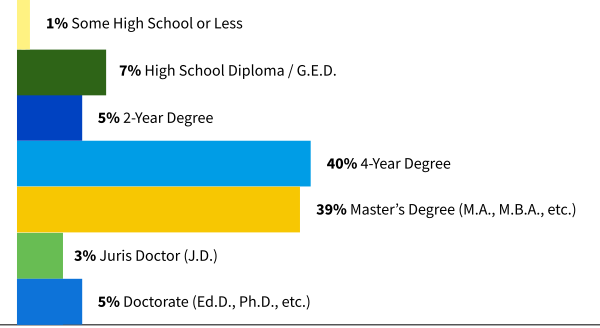
Highest level of education completed
This year, we saw more individuals with a high school diploma, G.E.D., or two-year degree. Education requirements in our sector tend to vary by role, but in the past there was often a bachelor’s degree-default on job descriptions. This breakdown of the highest level of education completed serves as a powerful reminder that workforce equity should prize experience whenever relevant over a degree.
Employment status
Given the shakeup in the nonprofit sector, it’s not a surprise to see that the amount of full time staff has dropped by 10% since last year (32% this year vs. 42% last year). That 10% is mostly disbursed into unemployed individuals, those that have retired, are self-employed, and those that have become students.
Job seekers and their behaviors
Every year, we try to pull apart the job seeker experience and ask various questions about what looking for jobs is like in this current moment. This year, we started that section with a simple question to find out who was interested in searching for jobs and internships right now.
What we learned is that 84% of all individuals are currently job seeking, whether they’re employed full time or unemployed. Even retired folks are job seeking, though at lower rates than their peers.
As we mentioned, we welcomed VolunteerMatch users to Idealist in 2025. Despite what one might imagine they’re here for—volunteer opportunities—this group is also searching for jobs (56%), adding to the diversity of work experiences represented among job seekers using Idealist.
When we dug into general job searching behaviors, we saw that job seekers are more likely to be frequently or constantly searching for and applying for jobs when compared with last year.
This bears out in site data as well. Comparing October 2024 and October 2025, when this year’s surveys launched, we’re seeing a 75% increase to job applications within our site and 28% increase to jobs with offsite applications. Given the trajectory of the data, we expect these figures to increase.
In terms of where job seekers are doing their seeking, when provided with several options and the ability to select more than one, 78% of respondents said they find opportunities via “specific websites like Idealist.” It’s important to keep in mind the variety of sources for job seekers, including online searches, word of mouth, and social media.
What Are Job Seekers Looking For?
We’ve discussed a bit about who nonprofit job seekers are, but what are they looking for?
Every year, we ask about preferred employer type. Fifty-seven percent of those surveyed are primarily or exclusively looking for social-impact jobs, which is consistent with what we’ve seen in past years. However, those that are “open to jobs of any type” have risen seven percentage points from last year to 37%.
From everything else job seekers are saying, they want a social-impact job, but with limits to what roles are available in the sector, job seekers are looking everywhere they can.
On the other hand, this presents an opportunity for socially-minded companies: dedicated, mission-driven talent with experience are re-examining their job searches with open eyes and considering other options.
What we can infer from career advice needs
To provide for our job seeking community, we continually create resources such as articles, tips, webinars, and videos. When we asked what career advice topics they’re most interested in, the two stand-out categories—when asked to select a top two—were “organizations and their jobs that might be new to me” and “sector switching.”
A curiosity about organizations that are hiring is no surprise, in a job market where so many are unemployed or underemployed, but it is notable that job seekers are keen to learn about more organizations. This gives an opportunity for smaller organizations to put themselves forward and make their presence known to job seekers.
Likewise, ‘sector switching,’ or joining the nonprofit sector from another, is another tell-tale clue about what job seekers want. Anecdotally, we know that for-profit sector professionals often tire of their careers, burn out, or are moved by social and political circumstances, and seek work with meaning. Recently, layoffs and furloughs brought government workers to nonprofits to continue their impact careers.
Employers should consider the candidates who want to bring their skills learned elsewhere into a new sector. With it, they bring experience that can yield results in many fields of work.
This year, “salary negotiation” was a selected career advice topic, but by a smaller margin than last year. Perhaps since we’re no longer in a “job seeker’s market,” salary negotiation isn’t as top of mind for seekers—while identifying hiring organizations and entering the sector are.
In the “Other” section, we heard about the challenges of ageism, returning to work after a career break, and the difficulty of breaking through an overcrowded market.
What We Learned From Social-Impact Hiring Managers
As mentioned, over 500 social-impact professionals filled out our hiring manager’s survey. They ranged in title from executive director to volunteer coordinator. Most have a staff of under 25 people.
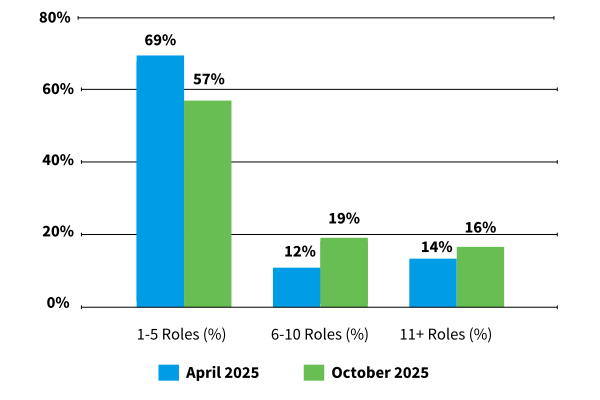
In April 2025, we conducted a pulse survey to better understand how sector instability would impact hiring trends, then asked the same questions in October to check in again. We found that current trends are leading organizations to hire less, and in fact, slightly more organizations are operating amidst a hiring freeze.
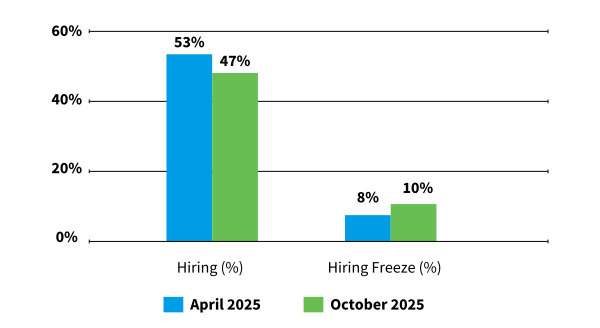
For organizations that are hiring, the number of positions they project they’ll hire for in the next twelve months has also shifted.
Benefits
We asked what benefits nonprofits offer prospective staff members to stay competitive. At least two weeks of paid time off is at the top of the list, a standard year after year. Since last year’s survey, more nonprofits are offering a flexible schedule outside of 9-to-5 constraints, paid parental leave, and a remote schedule.
Less commonly offered benefits include:
- Paid time off to volunteer
- Annual home-office stipend
- Four day work week
- Allowing pets in the office
In the “other” category, some write-in answers include:
- Commuting benefits
- Summer Fridays
- Loan reimbursement
- Employer-paid health insurance
- Unlimited sick time
While jobs in our sector typically can’t offer up salaries that rival for-profit companies, we know that offering useful benefits—and highlighting them in job listings—can often move the needle for professionals who want to find work with meaning. Next year, we’ll plan to ask job seekers what benefits they value most, so we can line up answers on both sides of the aisle.
What Idealist brings to the table
In the process of finding out more about the hiring manager experience, we wanted to know how they are using Idealist, as well as how we compare to other recruitment platforms.
We learned that hiring managers tend to hire for these kinds of positions, in order:
- Intermediate
- Entry level
- Managerial
- Director
Hiring managers consider candidates found through Idealist to be qualified (45%) or highly qualified (15%).
In short, Idealist is the meeting place of nonprofit hiring managers and social-impact professionals, united in the same goals. Job seekers praise “relevant search results” about what they like best about Idealist.
In the words of job seekers:
- “I have already recommended this site to the many other federal workers who have lost their jobs and many have found jobs that meet their mission and social do-good values - so this is a great site for us former feds who are still struggling to find work after losing our fed jobs that we loved.”
- “I have been using Idealist for yearrrsssss. It's been incredible to watch its growth and I'm extremely grateful the site exists!”
- “I love Idealist. Although I have a lot of experience in the nonprofit and government sectors, it is difficult to find opportunities since I do not have a college degree. Idealist is the only platform that comes very close. I really appreciate it and look forward to seeing even more!”
In the words of hiring managers:
- “Idealist's audience seems more dialed into and experienced when it comes to nonprofits. These are the types of leaders we look to hire. Cuts through to more qualified candidates.”
- “Strong non-profit professionals look here, and the applications have more thought.”
- “The quality of applicants is consistently impressive.”
- “In my experience, candidates coming from Idealist are likely to have a more thoughtful application, and be more passionate and mission driven.”
- “Candidates are generally mission driven vs. candidates from other sites.”
What Hiring Managers and Job Seekers Are Saying About A.I.
Last year, we began to survey about A.I., to learn more about how professionals were or weren’t using these tools.
From this year’s results, we learned that most organizations haven’t incorporated A.I. into their hiring process (54%). For those that have (31%), they’re mostly using it to create job descriptions and listings. From the “other” bucket, we found that hiring managers are summarizing job and applicant qualifications, and interview notes; and drafting candidate communications and interview questions.
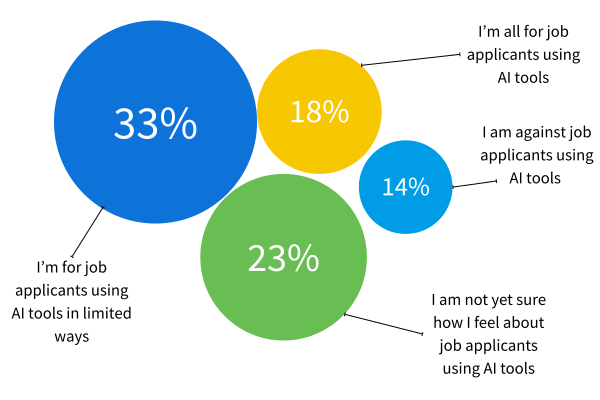
When we asked about candidate use of A.I., hiring managers seem split.
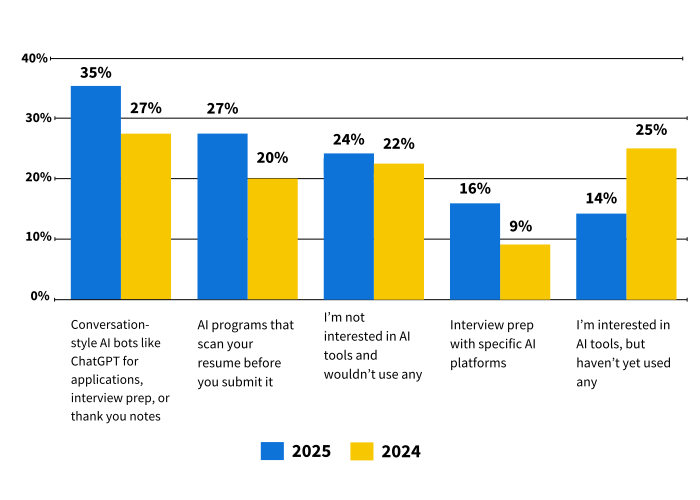
Shifting to job seekers, this group is using A.I. for career purposes in increasing numbers. Though some are disinterested, the majority are using it more and more to support their job search.
Last year and this year, we dug deeper on what technology they were using and their feelings on it. The visualization below shows the shifts in usage, where respondents could select more than one option.
In their words
- “let it be known i think AI is totally evil and i'm only using it because the job market is so competitive and i just can't afford to spend so long on each application”
- “Early in search, I used AI to improve a resume and cover letter. Was not impressed. More recently used it to suggest interview questions for a specific job. I don’t like the idea of it, but feel I have to consider it to be competitive.”
- “reference for what type of jobs to look for based on my past job experience”
- “It helped me find Idealist when I asked how to find more nonprofit jobs to apply for!”
Looking Ahead
As a new year begins, it does not seem that a stabilizing force is coming to the nonprofit sector. As disruptions of all sorts continue, what’s true is that mission-driven individuals all over the U.S.—all over the world—remain committed to building a better world. They show up on Idealist and offline, ready for a new job or volunteer opportunity. They are here, and they are not going anywhere.
Likewise, idealist.org enters our third decade of existence, armed with experience and community. We too remain committed to that better world, and to doing what we can to connect job seekers and hiring managers alike.
To post a job, internship, or volunteer opportunity, get started here.
To learn more about Idealist’s suite of services, click here.
To reach our support team, click here.

Ready to start hiring with Idealist?
Post a listing to reach thousands of mission-driven professionals.